



Registration
Friends of the RAS members will be emailed closer to the time with a link to register for this talk.
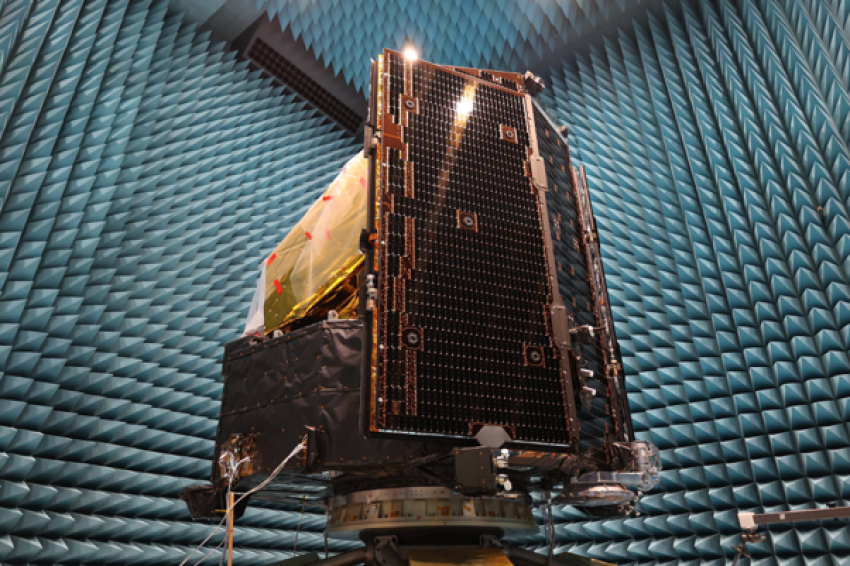
PLATO is due for launch in late March 2027, and will set off on a 4+ year mission to survey the sky for Earth-like planets orbiting Sun-like stars. I will introduce the PLATO mission, its current status (if all goes to plan, launched!) and what science we can expect from the mission. PLATO will revolutionise the field of habitable exoplanets, through finding terrestrial planets around stars bright enough that further, detailed characterisation is possible. PLATO’s 26 cameras will provide detailed, near-continuous photometry on at least 150,000 stars, enabling asteroseismology for a subset of them, where pulsations in the star’s interior can be measured to give insight on the fundamental properties of the star. Through this and other techniques, PLATO will reveal stellar ages, masses and radii at state-of-the-art precision. Using these ages, combined with the planets discovered, will allow us to map the evolution of planetary systems through time, taking us closer to understanding how our own Solar System fits in the wider galactic picture.
About David Armstrong
David Armstrong is an academic in the Department of Physics at the University of Warwick. His work focuses on exoplanet detection, characterisation and the uncovering of planet populations with the PLATO and TESS missions. He is a UK representative on the PLATO core science team, and works on preparing mission strategies for selecting planet candidates and targeting further follow-up on the best cases. Currently he runs an active UKRI Frontier Research grant, with the aim of uncovering the properties of hot, Neptune-like planets from TESS, while preparing for PLATO. Further interests are the habitability of known exoplanets, mixing exoplanet and Earth observations to track greenhouse gases, and the classification of eclipsing binaries and variable stars in large-scale surveys.
Many of these fields benefit from applying machine learning techniques to astrophysical and real-world problems, including the automatic selection and validation of real candidates in transiting planet surveys. Warwick hosts the RAVEN pipeline, a unified planet validation tool which can assess the probability of detected signals being true planets, allowing homogeneous statistical analysis of planet populations.
Outside academia, he serves as a District Councillor, pushing for rigorous, evidence-led improvements in local government. On the research side this has included connecting the above research techniques to wide ranging datasets, such as tracking wetlands and environmental markers using satellite remote sensing data.
This talk is exclusively for Friends of the RAS members
Want to attend talks like this? Learn more about becoming a Friend and get access to special events, talks, newsletters, and more.
Accessibility information
Please note that this venue is currently not wheelchair accessible as the ramp is temporarily out of order, and step-free access is unavailable.
We apologise for any inconvenience and are working to restore full accessibility.
If you have any access requirements or questions, please contact us at events@ras.ac.uk or call us on 020 7734 4582.